

This blog is about living your own life in a more sustainable way by making better choices about how you spend your money and your time. This post is about those things, my recent personal experience with environmental problems, and a few coping mechanisms.
I spend most of my life at home and at work, and in those two places it’s easy enough to understand what you need to do to live more sustainably. Travel is both a guilt trip and a reality check. It’s a guilt trip because if you want to get to most places, you need to fly, and when you get there, you can’t rely on the habits and services you use to reduce your waste and energy consumption at home. It’s a reality check because it forces you to take a close look at the state of the world, and it reminds you that no matter how much you do in your own life, you are one person among billions, and there are plenty of people less interested in protecting the environment than you are. The result of all that is easy to see.
I recently traveled to Brazil to see family and let my kids have a chance to connect with their other language and culture. We are raising them bilingual, and the four of us make it to Brazil about every other year. It’s a long trip – 3 flights in total, and generally a couple more within Brazil as we try to visit family and see a new part of the country. If we do the math, it adds up to nearly half our family’s annual carbon footprint. There are things to do to mitigate this, but they feel like a band aid. The only genuinely guilt free solution of carbon removal remains prohibitively expensive for a trip this long. I do look around for other means of travel, but there isn’t any viable alternative to get there. Replacing the domestic flight with Amtrak would take too long given the present state of our rail system, and sailing… well, I’d love to, but I’d need to be retired to find the time.
Away from home, there’s no compost and recycling is a lot less robust than it is in Seattle – sometimes there’s no bins at all, and other times they don’t accept everything. Of course, there’s also no Ridwell. At home, I’m proud of the fact that we have the second to smallest garbage bin available, and our family of four generally only fills it halfway up every week. Almost everything ends up being recycled, commercially composted, backyard composted, or donated. When we travel, we produce plenty of trash, just like everyone else. One incident really sticks out in my memory.
To cut down on flying, we hired a taxi for a long ride between cities. At one point, my son got motion sickness and threw up in the back of the car. Thankfully, we had a ziplock plastic bag. There I was, in a poor neighborhood by the side of the highway, with a zipped bag filled with vomit. I looked around and the unpaved street was filled with plastic trash. Our taxi drive said “joga aí no mato” meaning “just toss it in the bushes.” It would have just been one more disgusting piece of trash in an area filled with litter. Even so, I couldn’t bring myself to do it. I ran across the street and found what passes for a trash collection bin in this part of Brazil, which is just a basket where (theoretically) a collection service picks up bags of trash once a week and takes them to the landfill. Even that isn’t guaranteed.
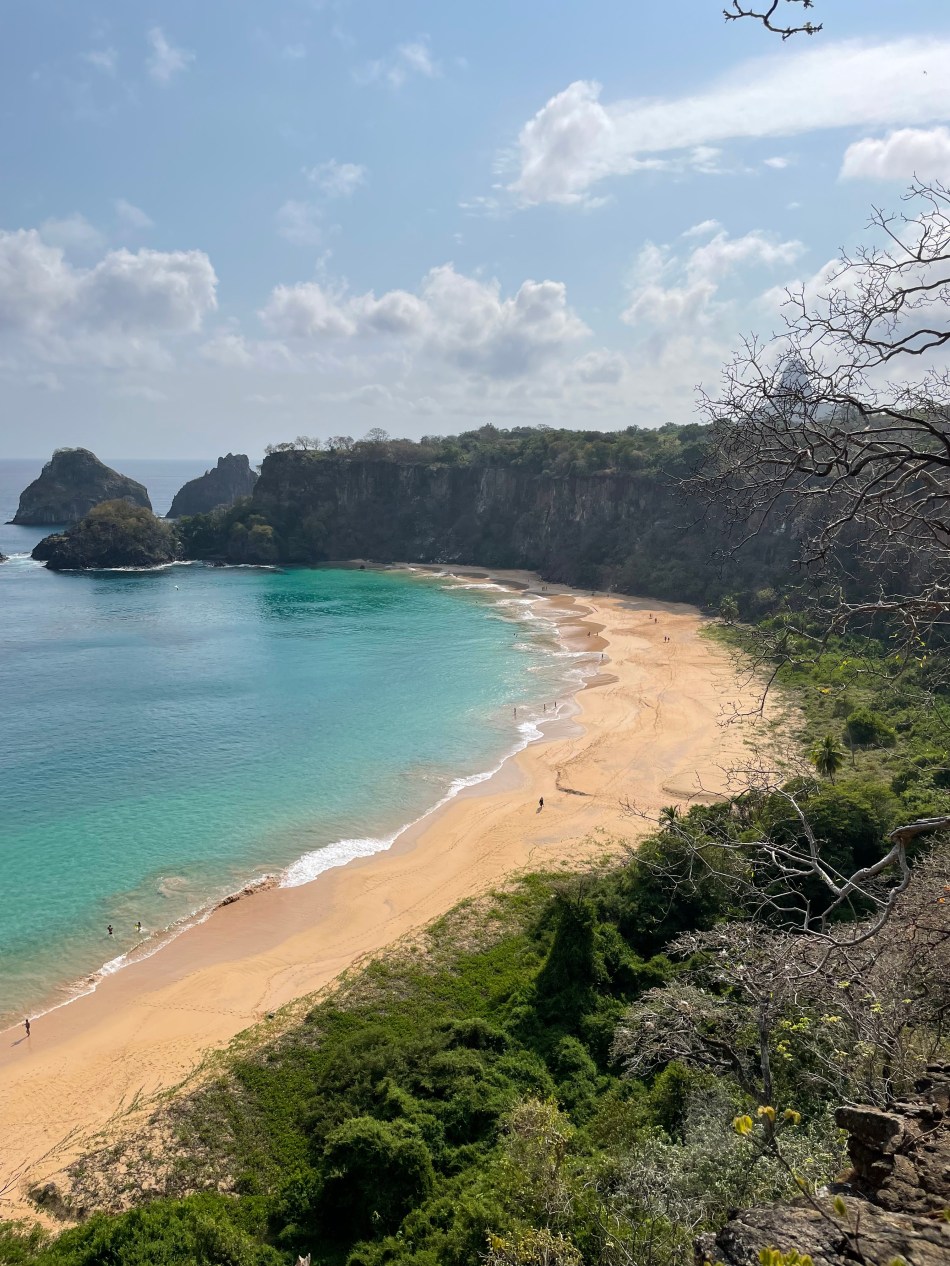
Plastic trash isn’t just something you find in the city either. We got a chance to visit the tropical island of Fernando de Noronha. This has been a bucket list trip for my wife and I for a long time. It’s like the Hawaii of Brazil – a nearly undisturbed island in the Atlantic. The beaches are beautiful and the wildlife is abundant.

Almost two thirds of the island is a national park, and the local government has been pushing sustainability initiatives. There are electric taxis, an office for Project Tamar where we listened to a biologist speak about the local dolphin population, and signs for a “plastic zero” vision. It’s a place of contradictions in that regard. The straws are compostable but there’s no compost. The water bottles are plastic but at least within the national park there are fountains where you can refill your water bottle for R$3 (about 75 cents in USD.) The taxis may be electric but the electric grid is powered by diesel, supplemented by the occasional solar panel. The food is excellent but it’s as expensive as it is in Hawaii, and there’s no kitchen to cook for yourself in the hotels. But for all its faults, it’s a place very much worth seeing.

We saw sharks, dolphins, whales, sea turtles, crabs, tropical fish, and of course, plastic. On one excursion, we hiked to an isolated beach on the windward side of the island.

There, far away from the roads and the town, I found fragments of plastic trash swept in by the tides and the wind and deposited on the beach.

Disgusted, I started collecting trash. I know, it’s futile, but I did it anyway. I combed the beach and ended up with a few handfuls of plastic, which I carried back with me on the trail in my backpack. The woman at the entrance didn’t even blink when I showed it to her.

To go to the remote part of the islands, you need to hire a tour guide. Our guide told us that when the locals do beach clean ups, the writing on the plastic is rarely in Portuguese. He said most of it comes from Europe or Asia, and indeed the winds take it from East to West. I’m not sure what to believe as most of it looks like it came from plastic bottles.
The literal plastic on the beach got me thinking about the album Plastic Beach by Gorillaz and especially the song On Melancholy Hill. Merdoc describes it as “that feeling, that place, that you get in your soul sometimes, like someone’s let your tyres down.” I find that feeling inevitable when confronted with the scale of our environmental problems. Noronha was a tiny island outpost that remained nearly uninhabited for centuries because it lacked freshwater. It’s only recently that people have started thinking of it as an “island paradise,” and that’s because so much of the rest of the world has been degraded by humankind. The whole coastline of Brazil used to be just as beautiful and wild as Fernando de Neronha – but now 88% of the Mata Atlantica has been destroyed. Thanks to “changing baselines,” we tend to think of the world we grew up in as normal and see the steady destruction of the environment during our lifetime as harm, but the destruction has been going on for centuries.
So what? Does this just continue until everything is gone? We depend on our Mother Earth for survival, but so many people seem not to even care. Why? What the hell is wrong with us?
Of course, not everyone is like that. There are plenty of groups fighting to protect what is left, and in some cases, restore what’s been lost. More often than not, all this feels like too little, too late and I get caught up in poisonous rage, despair, or a desire to turn away from it all. We humans are doing the wrong thing, and I participate in that. I could try to abstain from traveling, but then I’d just be keeping myself and kids from seeing the world while everyone continues doing what they are doing.
And how do I cope with that?
I sit once a day and meditate. I think about giant time scales – from the Permian to the Anthropocene and remember how many species have emerged and gone extinct. I think about the Earth as a tiny speck in a giant galaxy, and I feel small. A speck on a speck, worried about a speck. It helps me not to cling to an impermanent state in a changing world.
I remember as well that I am alive and I have to live. Living in accordance with what I think is right is all I can really expect of myself. I can’t move the world by myself, but I can drive myself crazy trying. I can find relief in creative expression and music, and I can be happy spending time with the people I love most.
When we find solutions to our environmental problems, we need to adopt them. When we don’t, we need to invent them and push them forward. But sometimes, we just have to live.
 greenfyi.com
Pingback: Sustainable Aviation Fuel (SAF)