

Flying is a bear. I’ve found ways to very significantly reduce or eliminate greenhouse gas emissions from most of my personal life, at least on a day to day basis, but flying remains the one thing that’s difficult to do without where there’s no decent sustainable option. For the most part, we’re left with tools like carbon offsets that represent highly imperfect guilt alleviation tools at best. There are ways to scrub the emissions out of the atmosphere entirely, but they are too expensive to offset a flight at this juncture.
The best thing to do, of course, is to fly as little as possible. I’ll have a post about vacationing with minimal flying later this summer. For now, I’ll just mention that after an international flight, I got around Europe just fine by train. Surprisingly, the Italian trains were fast and reliable. The sleeper train from Germany to Italy was also a nice way to travel overnight and avoid paying for a hotel.

But let’s face it – I’m going to fly, at least a little bit, until I retire and have enough time to get across the world without stepping into an airplane. For now, I’m going to be left with those imperfect tools for guilt alleviation.
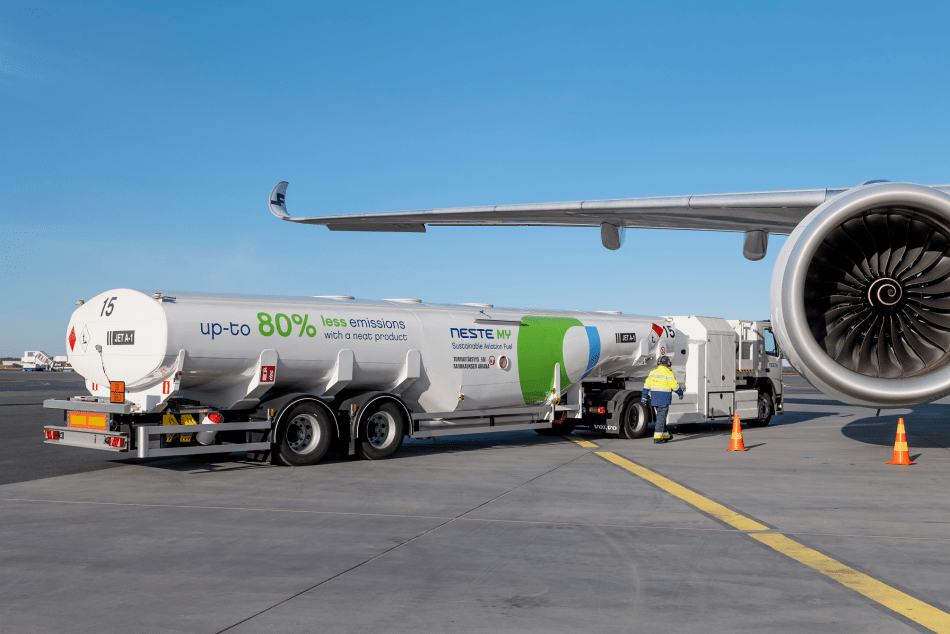
That brings me to the point of this post – a new and slightly better form of guilt alleviation – SAF. Sustainable aviation fuel is made from waste and blended with traditional jet fuel to lower the overall GHG emissions from flying.

A new company called Azzera is making it possible to book and claim sustainable aviation fuel the way that you can book and claim credits for renewable electricity generation. Azzera explains it like this:
Electricity providers were among the first to introduce the Book and Claim systems. All electricity, produced from renewable sources or not, is combined before getting to a power outlet. Hence, we can’t track who exactly uses the more sustainably produced electricity. This proved to be a challenge for consumers measuring their environmental impact and reducing CO2 emissions.
To solve this dilemma, electricity providers would “book” the renewable share of their productions so their customers could “claim” the green energy they have bought. For instance, if 40% of electricity sold had been sourced from renewable sources, every customer could claim the same thing regardless of the physical flow of the energy.
Accordingly, someone claiming the environmental benefits might not have even used any of the renewable energy portions of the electricity, yet as they have financially supported the process, the chain of custody model allows providers to de-couple these benefits from the physical product and transfer them separately via a dedicated registry.
We can apply the same logic to the sustainable aviation fuel supply chain as dedicated registries track and document the production and ownership of the physical fuel. After that, the environmental benefits of the Biofuel are isolated and transferred separately. Therefore, the buyer and seller of the fuel don’t need to be connected through a physical supply chain.

The point of the credits is to speed up the development of SAF supplies globally, whether a drop of the stuff makes it into the jet you fly on or not.
What is SAF and is it a boondoggle?
Sustainable aviation fuel is fuel that has similar properties to jet fuel but comes from sustainable or renewable sources such as biomass or agricultural waste. Ideally, the fuel would be made from a feedstock that would otherwise go to waste (such as tallow) and hydrogenated with green hydrogen. The result is a fuel that reduces total emissions by 80%, according to Airbus. That qualifies as a ‘substantial reduction’ in my book.
Some have called the whole thing a boondoggle, and they have a point. That point is that SAF represents a tiny share of total aviation fuel, and even today, it generally has to be blended with traditional jet fuel to power conventional aircraft. Azzera has a chart that illustrates the problem quite nicely – SAF is more than twice the price of jet fuel and only 0.24 MT of it was produced in 2022 vs 254 metric tons of conventional jet fuel.

The SAF story will be greenwashing iif the aviation industry just sprinkles a little SAF into their fuel tanks to pretend that they are doing something.
The good news is that SAF production appears to be rising quickly after a slow start, and you can push along the trend by buying credits yourself.

So, what’s it cost?
As of this writing, $7.70 / Gallon.
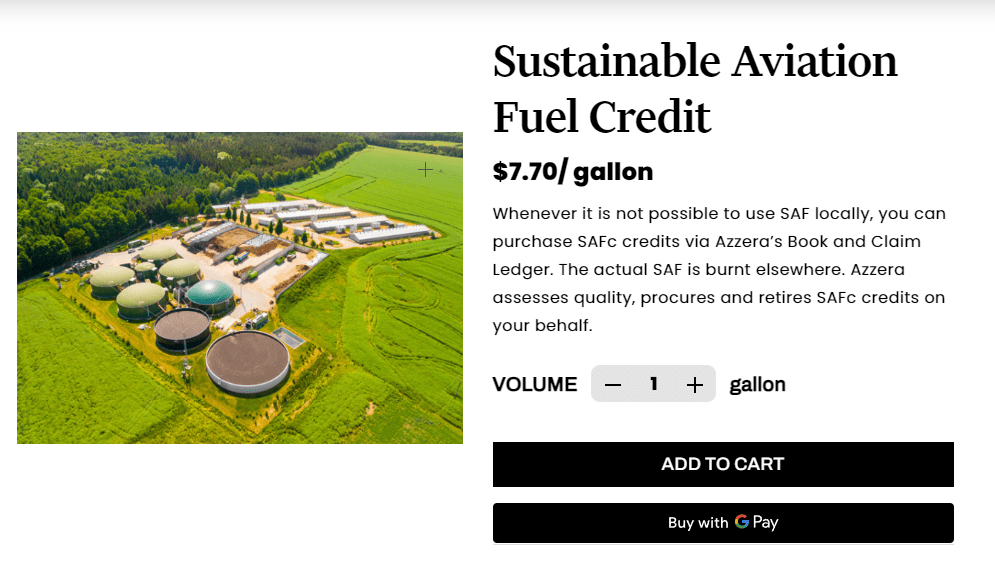
A flight from Seattle to Tokyo on an efficient modern airplane will consume roughly 2,900 gallons of fuel per hour * 10 hours / 300 passengers = ~97 gallons of fuel. SAF credits to cover a one way trip would cost about $745 – hardly cheap, but when you consider that there are no alternatives to flying if you want to go certain places and don’t have weeks to spare, it might be the only way to make the trip less damaging to the environment.
I bought credits myself and got a call from Anant Jain, Azzera’s head of Carbon Mitigation, the next day. He was surprised that an ordinary consumer (not a business) had found the company and bought credits on their own. Apparently that doesn’t happen very often. Afterwards he sent me a certificate for the retirement of the SAF credits.

In my view, avoiding flying is best, but when you can’t, this is something worth doing. Spread the word.
 greenfyi.com
0 comments on “Sustainable Aviation Fuel (SAF)”