

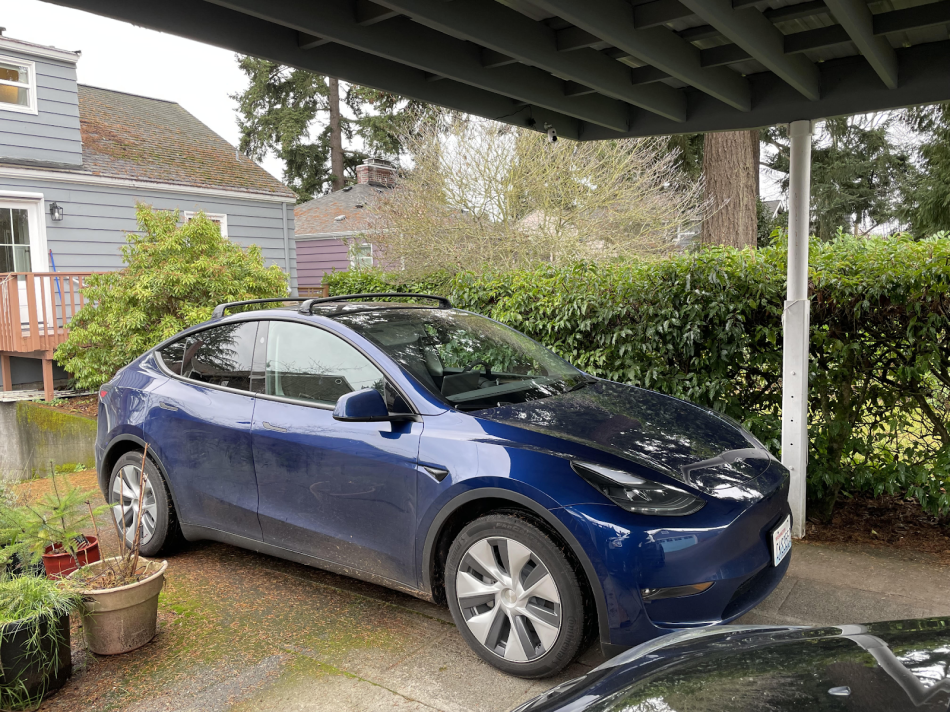
After thinking about it for years and saving up some money, I finally bought an Electric Car.

My wife and I narrowed down our choices to the excellent EV6 from Kia and the ubiquitous Tesla Y. I’d been resisting getting a larger vehicle for years, but camping with the two kids was increasingly leading to our compact car getting stuffed to the gills, and ultimately picked the Y because of its impressive amount of cargo space. I also didn’t really consider it in my purchase decision, but the supercharger network has also been very useful and reliable on our occasional road trips.
The point of this post is to tell you what it’s like to drive one as my primary vehicle (supplemented by my powerbike) and how I weigh the environmental and personal costs and benefits versus other options. I also think I can clear up some misconceptions with data and personal experience.
No More Gas Pump!

Climate change is by far the greatest environmental problem in the whole of human history. It is already the cause of mass extinction and terrible human suffering. For the sake of my own sanity, I have committed to contributing as little as possible to the problem. Some things are impossible to decarbonize right now, but where there are solutions, I’m going to adopt them. And there’s a solution to driving.
Every time I pull up to a gas station, I feel that I’m committing a crime against the future. Two thirds of US gasoline comes from Fracked Oil, which has a carbon intensity that’s as bad or even worse for the climate than burning coal. This isn’t some small part of the problem either. Driving accounts for about 20% of total US greenhouse gas emissions according to Statistica. The EPA publishes a similar figure:

To make matters worse, when I fill up my gas tank, I’m making a political contribution to people and causes I find abhorrent. Here’s the chart from statistica of the oil industry’s lobbying spending by political party.

If you want some detail on who’s who, look at open secrets.
If the pollution isn’t already enough to make you feel awful, remember that you’re contributing to Trump, to defunding the EPA, to election denial, banning abortion, tax cuts for the rich, gerrymandering, and pretty much every revolting right wing cause with every gallon of gasoline.
By contrast, the electricity I used for charging comes overwhelmingly from renewable and non-emitting sources and is provided by a utility owned by my local government. Here’s Seattle City Light’s breakdown of energy sources, both for regular customers and for people like me who pay a bit extra for the green up program.
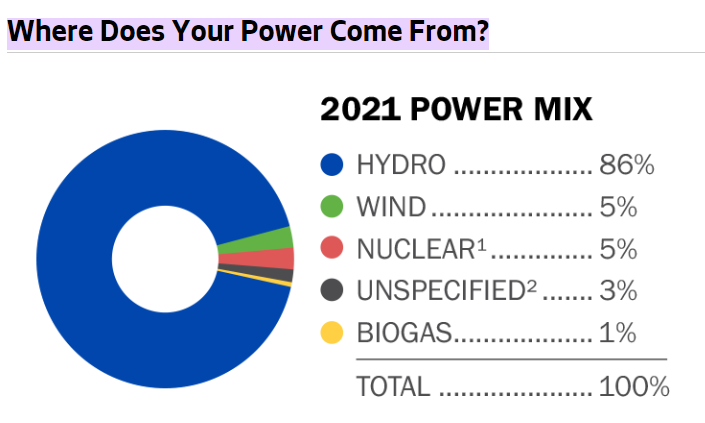
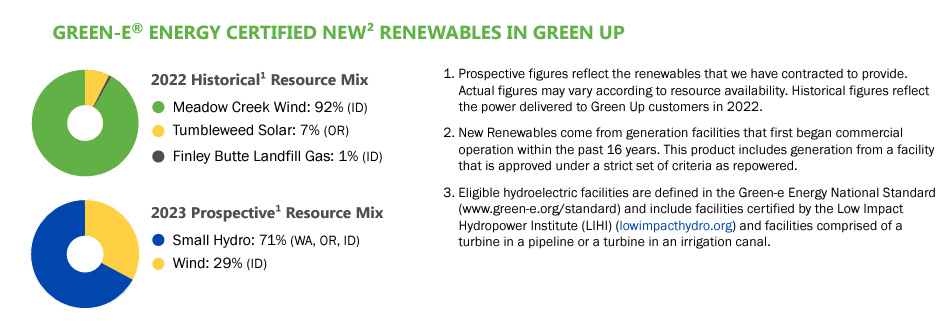
So, my daily contribution to the single largest problem in human history from my commute and kids activities just went to right around zero.
Whether you can do the same, of course, depends on where you live and what the mix of power is for your local utility. For most of the country, according to the EPA, EVs will have a much lower greenhouse gas profile than comparable conventional vehicles. Data from MIT shows the same thing.

Of course, the carbon intensity of electricity differs quite drastically by region and state.

Whether an EV has lower emissions than a gasoline hybrid car depends on where you live, and the EPA even has a calculator to give you the answer. Here is mine.

It is true that producing an EV is more carbon intensive than a conventional internal combustion engine (ICE), but this is more than outweighed its lower emissions from operations.It’s not even close.
There are plenty of people who will say that forgoing driving all together and relying on bikes and public transit is a better solution. I respect that point of view, and when I lived by myself I could just about do this. Now that I have two children, I find it next to impossible. I still bike and ride public transit to work about once a week, but day to day, I always found myself turning to a car to get around. For most Americans who don’t live in the handful of cities that have excellent public transportation systems, I suspect it’s the same.
Instant Acceleration, Superior Handling, One Pedal Driving, and Less Maintenance
Electric cars are a joy to drive – so much so that over 80% of EV drivers never switch back to gas powered cars. The experience of driving is very different and a whole lot more fun. When you step on the accelerator, you get an immediate response with a whole lot of torque.

The transmission has only one gear, and there’s no vibration at all from the electric motor. There’s also no noise. The result is a smooth ride that not even the most expensive gas powered cars can match, and a degree of maneuverability and acceleration that tops all but a handful of extremely expensive supercars. Yes, the top speed is lower, but if you go over 110 mph you are likely to get your license pulled and spend some time in jail – unless you happen to be on a race track.
Another thing I’ve really learned to appreciate is one pedal driving. Regen braking does the work of slowing the car down and recharging the battery in the process. The result is that I rarely touch the brake pedal. Once I got used to that, it’s a whole lot more comfortable in stop and go traffic.
On top of all that, you don’t have any oil to change and the brake pads last as long as 100,000 miles, though manufacturers recommend you replace them no less than every 5 years. There’s also no timing chain or belts to wear out, no spark plugs to change, or anything else.
Charging
When you hear about why people are reluctant to switch to EVs, the lack of public charging is usually at the top of the list. What most people don’t realize is that when you drive an EV, you’ll rarely charge away from home. My routine is really just to come home, put the car in the garage, and plug it in. The next morning, it’s charged to 80%, the recommended limit for daily driving. It’s about as convenient as you can get.
If you own a home or rent one with a garage that contains a power outlet, you’re set. Having a 240V outlet makes it a lot faster, but I’ve read stories online about people who get away with level 1 charging at home for their daily routine. If you do this, you will basically need to keep your car plugged in all the time whenever you’re at home. With a 240, you can get a full charge overnight.
I realize that the need for home charging is a drawback for a large set of people. If you live in an apartment with a garage where you can’t charge your car, or if you park on the street with no access to electricity, owning an EV is going to be difficult. Hopefully this changes over time.
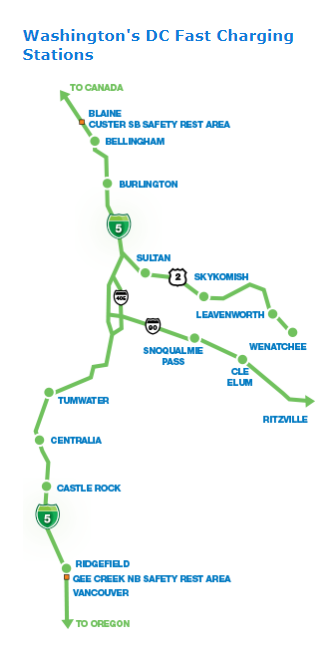
When I have taken road trips, I’ve found the charging infrastructure in Washington State to be quite good. The I-5 corridor along the West Coast has earned the nickname “Electric Highway,” and the East – West corridor for I-90 has its share of chargers as well.
Here is the map of Tesla Superchargers, which are now open to owners of all compatible EVs.

And here are other fast charging stations in Washington State.
That said, when you go on a road trip, you’ll need to plan ahead. A level 2 charger will take as long as 7-8 hours to charge your car from empty to near 80%. That’s fine if you’re staying overnight, going for a long hike, or spending the day at the beach. If you need a quick top up before continuing the journey, then you’ll need a level 3 charger. A supercharger can get you 200 miles of range in about 15 minutes… but that’s if you drive slow. I’ve found the rule of thumb is to cut that figure in half at fast highway speeds.
On balance, I’ve certainly found driving long distances a little less convenient than my old gas car, but when it comes to day to day driving, charging more than makes up for it. I think it’s made life a little easier. And the price is certainly right. An 80% charge costs about $10.60, and I go through that about once every two weeks. That’s about ⅓ of what I used to spend on gas.
But won’t you need to replace the battery?
I hear this a lot too. The answer is a firm ‘no.’ The media’s answer is that a battery lasts 100-200k miles, but I’ve read online that it can be even longer. If you follow recommendations and charge to no more than 80% day to day, the batter is likely to last a very long time. I frequently see even early model Nissan Leaf’s on the road, and the current generation of EVs will probably be around even longer, though they’ll be more suitable for day to day driving than road trips.
Efficiency
EVs are drastically more efficient than their gas powered counterparts. The comparison is especially stark when you convert efficiency into MPGe (miles per gallon equivalent) for comparison with gas powered vehicles.
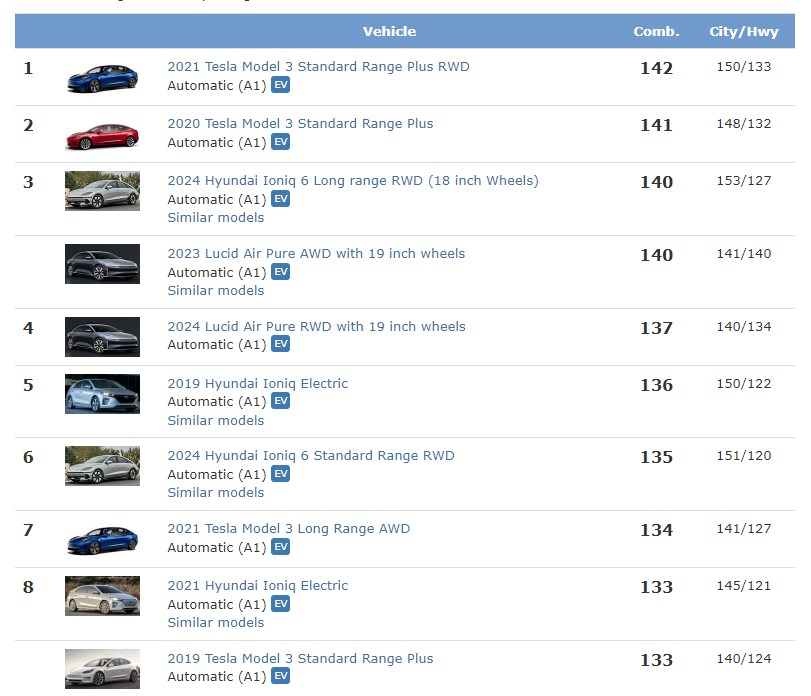
Compare that to gas powered cars:
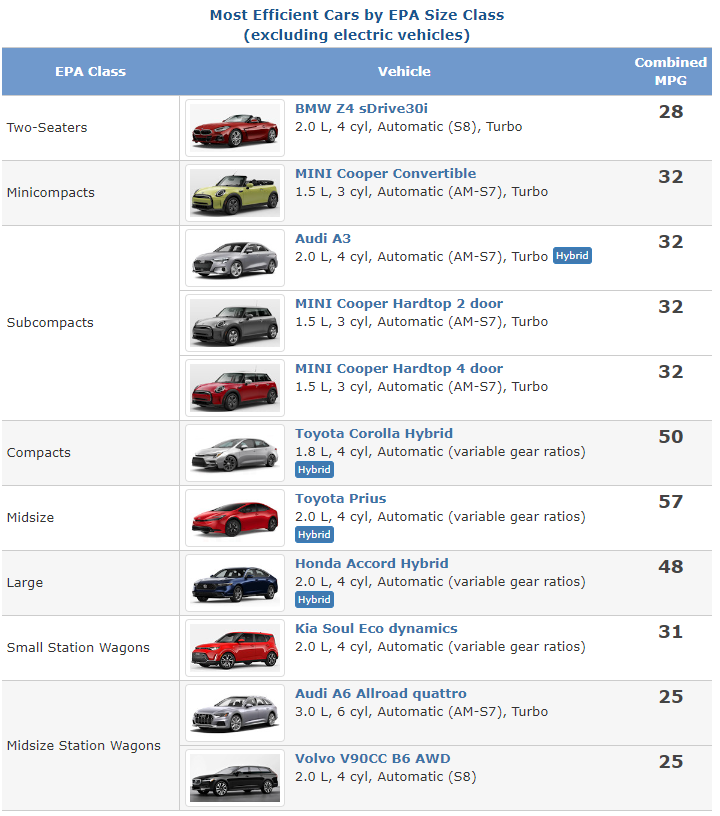
And those are the best! The RAV4, which slightly outsold the Tesla Model Y, gets about 30 miles to the gallon according to the EPA. My Tesla gets the equivalent of more than 4 times that in the city. One very handy and initially counterintuitive feature is that EVs are more efficient in the city and with stop and go traffic than they are at highway speed, which of course aligns with where I drive most of my miles.
Scalability
But wait, won’t all that extra electricity collapse the electric grid? Of course not. An EV will on average consume around 4,000 kWh per year assuming you drive around 13,000 miles per year like the average American (I don’t). That’s about 1000 kWh more than your average electric water heater. Push as hard as you can in the direction of efficiency at home, and you might find that even with an EV, your power bill won’t be much higher than before. For example, just switching out an ordinary electric resistance water heater for a modern heat pump / hybrid heater can save you nearly 2,000 kWh / year, which is about half the required energy for an EV.
The Environmental Costs
All this comes with a cost… but it’s one well worth paying to decarbonize.
Batteries require a selection of uncommon minerals, and mining and refining are going to have to be scaled up dramatically to replace gas powered vehicle demand with EVs.
There are two different chemistries available now: the Lithium – Aluminum – Nickel – Cobalt combination that’s most popular and Lithium Iron Phosphate, which uses elements that are relatively common on our planet.
To meet demand, we will need to scale up mining in places like Chile, Bolivia, Argentina, Ghana, and the Congo. This is both an economic opportunity and a potential disaster. Countries like Australia and Norway have been able to attain prosperity by exporting commodities, but many others have fallen victim to Dutch Disease and corruption.
How this turns out depends on the quality of the government and institutions and the commitment of the companies that mine to the rule of law and paying their tax revenue. I’m a lot more optimistic when it comes to Western mining companies than I am about the Chinese companies that dominate the battery supply chain.
The Economics
Ok, what about the cost? The Y I bought was a lot more expensive than my Ford Focus, bit it’s hardly possible to buy a new car for $16k anymore. There are are much cheaper options than a Model Y Long Range. A base Model 3 goes for less than $40,000, and you can get an EV6 for about the same. The sticker price is a bit more than a conventional car, but you’ll spend half or less as much money on electricity as you do on gas – provided you can charge at home.
Other maintenance like oil changes and brake pads represent savings vs gas, but you’ll still need to change your air filters, lubricate the doors, and maintain the suspension.
There are two operating costs that will be higher:
- Collision – there just aren’t enough people qualified to work on Teslas and other EVs, which means longer waiting times for collision repairs and other services.
- The tires wear out faster. My model Y’s tires are projected to last 20-40k miles, which is a bit shorter than a conventional car. I’ll need to rotate them every 6k miles as well to extend the life. Part of the problem is the car’s weight, and the other part is that instant torque is fun but wears out the tires. To mitigate the problem, I set the accelerate mode to ‘chill.’
My Own Personal Challenge
The average American family of 4 uses 10,500 kWh of electricity per year according to the DoE. That’s 875 a month. I’m a little ahead of that at 970 a month for October / November, but that’s in the late fall. My bill includes my electric heat pump.
My challenge for 2024 is to see if I can keep my electricity usage below average for the full year while using a heat pump to heat my house and charging an EV at home for about 90% of my driving.
I’ve already got efficient appliances, smart plugs, and fairly good habits. To get there, I’ll need to do a few home projects and improve my insulation. I’ll also need to take public transit to work once a week on average.
I’ll check back in after a year and see how I’ve done.
 greenfyi.com
Pingback: Camping with the Tesla Y (EV)