

Let me begin with some obligatory and legally required throat clearing.
- I am not your investment advisor. In fact, I’m not an investment advisor or a wealth management professional at all. If you need investment advice, find someone who will have fiduciary duty to you and then make sure that their interests are aligned with yours – that way you won’t just get milked for fees. If you feel like you want to go it alone, there are plenty of articles and tools out there to help you, and some simple options to set your investments on autopilot with a minimum of fees and fuss, like target date funds.
- I don’t get paid for anything I write in this blog. No product sponsorships, etc. It’s just things I’ve tried myself and that I like. You are free to try and like or dislike whatever you want.
Ok, with that out of the way…
I’d said awhile back that I wanted to heat my home with a heat pump, drive an EV, and still consume (net) less electricity than the average American household and source it all from renewables. To that end, I’d looked at a lot of home efficiency projects (blog post forthcoming at some point) as well as balcony solar. On a recent trip to Germany and Austria, I saw a massive amount of solar in every city and small town and read about how easy it is to set up a DIY system for very little money to generate a meaningful amount of power to use in your own home.
For me, the idea was that I don’t have a great house for rooftop solar (due to the beloved Douglas Firs next door), but I’d thought I might be able to stick a much simpler system on my car port and plug it into an external wall outlet and make that work in a cost effective manner. Unlike a complete rooftop system, balcony solar won’t feed energy back into the grid, but because you’re generating < 1kW, you won’t really have any surplus power anyway.
Well, surprise surprise, the USA is way behind Europe in this regard and I did not find any system that I’d trust to just plug and play. There appears to be some on the way (Bright Saver), but nothing here yet. I also looked at at home wind generation, and concluded that it’s great if you live on a windy coastline or up in the mountains, but where I am it would not do much good. So I looked around to see about buying into community solar projects in the area using more suitable rooftops, and I found something interesting.
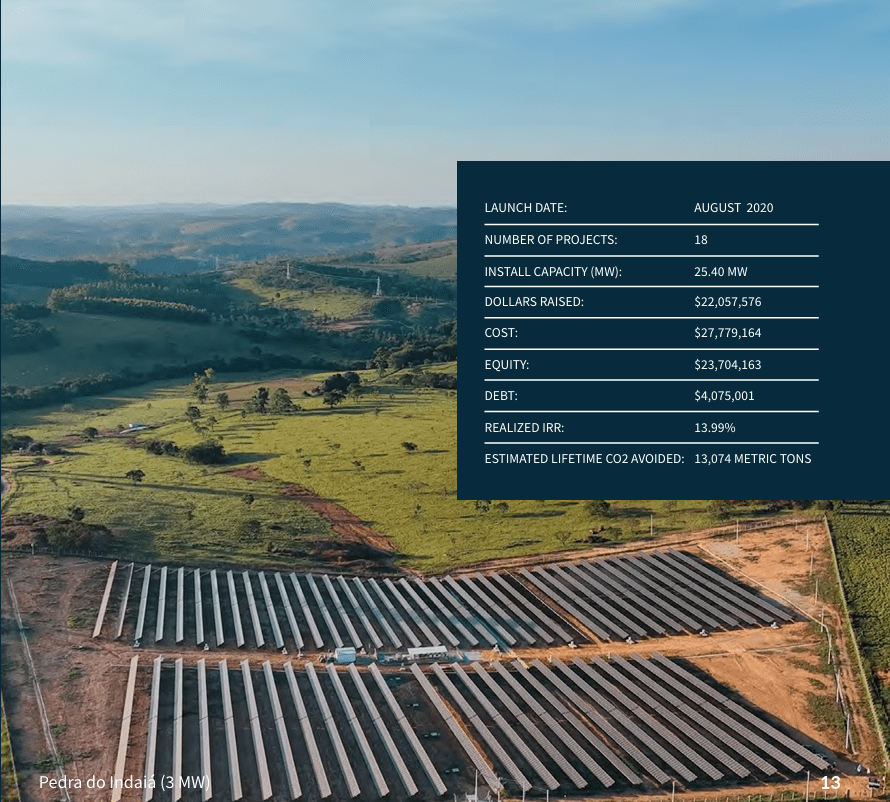
Energea happens to be the intersection of three things I want to do: take advantage of very high interest rates in Brazil (14%!!!),make an investment in renewable energy, and diversify away from just stocks and bonds. Their Brazilian Community Solar fund has a 24.4 MW installed capacity (as of 2024) and 13k metric tons of CO2 emissions avoided since inception (2020). Because the cost of capital in Brazil is so much higher, the fund has a realized IRR of ~14% (in USD terms, accounting for the exchange rate) and room to grow. Energea also has a South African and USA fund, both of which have lower returns.
What’s not to like? Well, one drawback is that the funds require a 3-year lock up, which is something I wholeheartedly support as it allows them to commit to projects, but it does mean that you should not invest money you’re going to want soon for another purpose (but you should not be doing that anyway). Another obvious problem is that the IRR is based on a cash dividend (easy to measure and verifiable) and a mark to model / estimate of the value of the project, which is somewhat subjective and less reliable. Finally, there’s foreign exchange and investment risk – the Real or Rand can depreciate vs the dollar, and any solar project faces technical and financial risks.
On balance, I like this and have a pretty modest investment that I plan to increase over time. It’s nice to have an investment that aligns with your values, and even nicer if that investment produces a decent return.
 greenfyi.com
0 comments on “Energea”