

I’ve written before about getting an EV as well as how to benefit from time of use rates and off peak charging to cut down on the cost of charging your car. Beyond this, it turns out there are other major economic and environmental benefits for making your next car electric.
Let’s start with maintenance and fuel costs. EVs contain far fewer moving parts than combustion cars, leaving you not having to worry about oil changes, water pumps, timing belts or chains, spark plugs, and a whole host of other parts that wear out on an ICE car within a decade. The flip side is that EVs are a little heavier than comparable gas-powered vehicles, and they have a lot of torque from a dead stop, leading to greater wear and tear on tires. The result is that tires will last only 30-50k miles, and you will need to budget for replacements. To extend the life of your tires, you should rotate them about every 5,000 miles, make sure your alignment is in good shape, and avoid driving like a crazy Italian. Aside from this, you are just going to need some really cheap and easy stuff like replacing your air filters and wiper blades.
For the sake of a clean example, let’s look at the IONQ 5 vs the Tuscon, also from Hyundai. Overall, you end up paying $7,225 to maintain the IONQ 5 over a 10 year period according to Auto Cost Index, which is about middle of the pack for popular EVs.
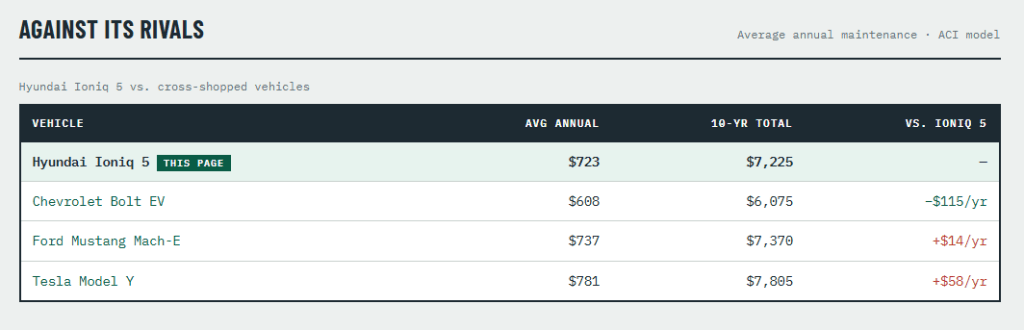
This ends up beating the Tuscon by about $1,300 based on comparable figures from CarEdge.
Fuel costs are the other big advantage. Here are the inputs the total cost calculation:
- The Tuscon gives you 28 mpg combined city / highway
- Average gas prices are $4 nationally right now
- Let’s say you drive 12,000 miles a year, which is around average
- For the electric car, let’s assume a 11 cent / kWh off peak time of use rate. The Ionq gets you 3.2 miles / kWh
So, in gas you’d be paying $17,140 over 10 years vs $4,130 in electricity, so cool $13,000 in savings by driving electric. Keep in mind as well that you can save even more if you generate your own power via a solar system or some other renewable solution or if you have access to even cheaper off-peak electricity like I do.
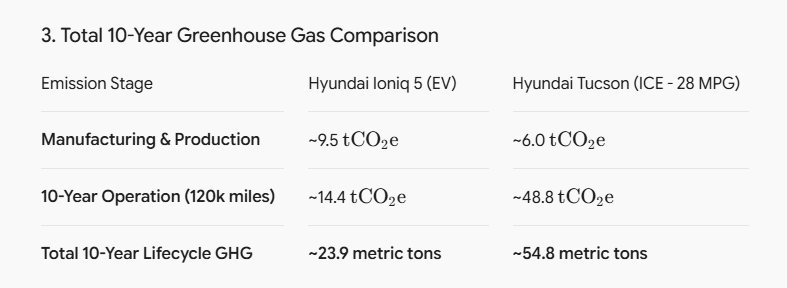
When it comes to emissions, the EV advantage is much larger. Building a midsize ICE SUV will emit 5.5-7 metric tons of CO2e vs 8.5-11 MT for an EV, but over a 10 year timespan, the Tuscon emits about 49 mt of CO2e.
Now, if you are getting your power from low emissions sources like renewables, the emissions associated with use drops to nearly zero. You can choose to do this in many parts of the country. The figures below are based on the national average carbon intensity of the electric grid.
Now, Longevity
When EVs were first introduced as mass market products, there were a lot of fears that the batteries would wear out quickly, leading to massive out of pocket costs to replace them. It turns out that a lot of that was propaganda from the Kochs and others, sometimes spread through social media. The propaganda covers battery longevity, flammability (ICE cars burn more often than EVs), and cold weather performance. Most of this has proven to be bogus..
Well, we now have data from EVs that have been in the market for a long time, and the results look far better than expected. Battery life was initially tested by repeatedly fast charging the battery and then discharging it quickly. That’s the equivalent of charging at the fastest charger you can find and then getting on the highway and flooring it until the battery runs out, then doing it again. That’s not how people actually drive (aside from the aforementioned crazy Italians). According to geotab, battery degradation is 1.8% per year, leading to battery life in excess of 20 years.
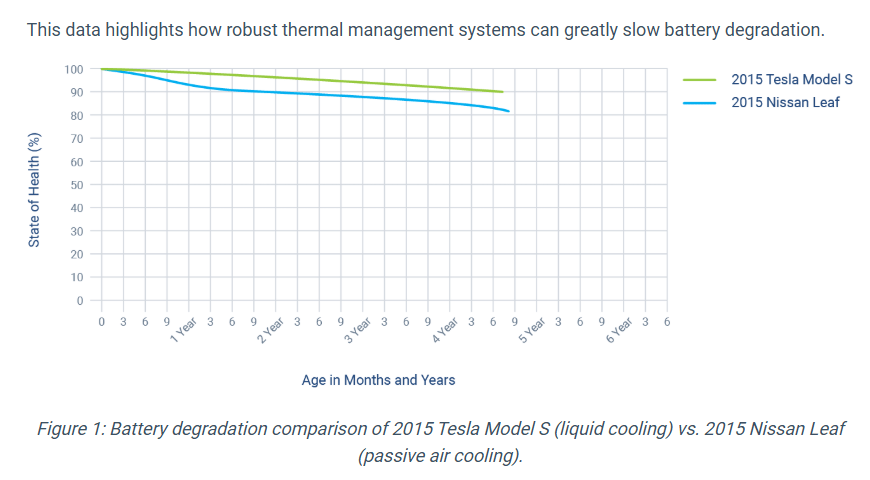
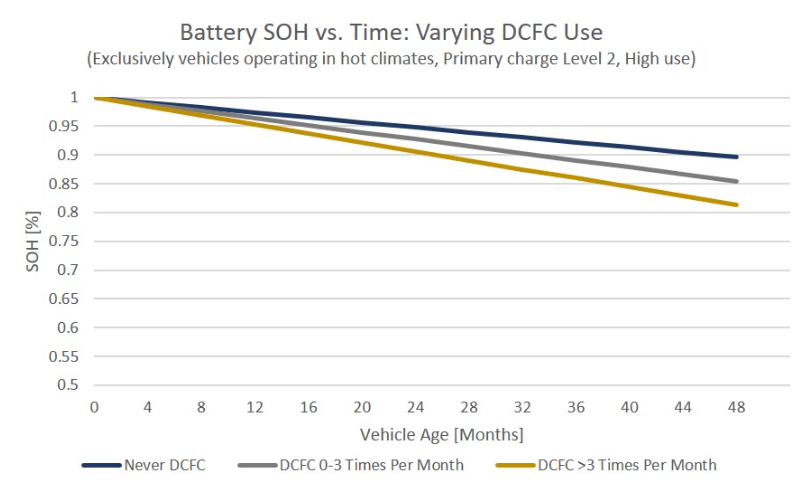
There are several things you can do to extend the lifespan of your battery:
- Charge to less than 80% for daily driving. I charge mine to 60% day to day and 80% if I know I’ve got a road trip of some sort ahead of me, like going skiing.
- Charge at home instead of fast charging when possible. This is the cheapest solution anyway. However, beyond the obvious, you can sometimes charge on a 120V outdoor outlet when camping or staying with friends.
Last of all, remember that this improves through time as technology gets better. The data we have are from older models, most of which are still on the road!
Overall, the result is that EVs last much longer than comparable internal combustion engine vehicles. Fine examples include the Chevy Volt and Nissan Leaf, many of which are still on the road. Data from the UK shows that 75%-80% of the first generation Leafs, produced from 2011-2013, are still on the road.
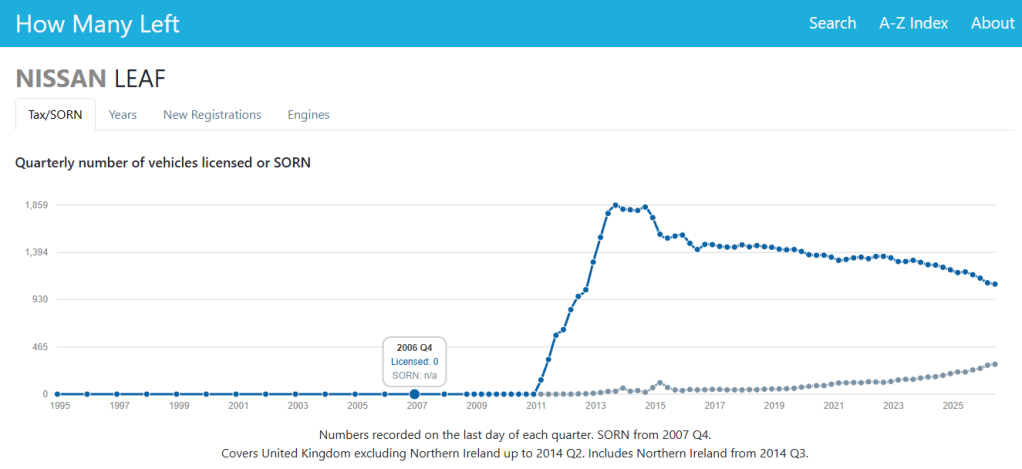
(SORN = Statutory Off Road Notice, for those of you that are not British stat geeks)
Teslas regularly cross the 200,000-300,000 mile mark and you can find some rather extreme examples of rideshare drivers taking them into very high mileage territory. Note that the range does shrink over time on the original battery, but the car remains useful and on the road.
Conclusion
Let’s run the calculation again with a 7% discount rate / cost of capital but extending the time frame from 10 to 20 years. The Ionq 5 Comes out even further ahead. I am somewhat lazy and used Gemini to do this rather than excel.
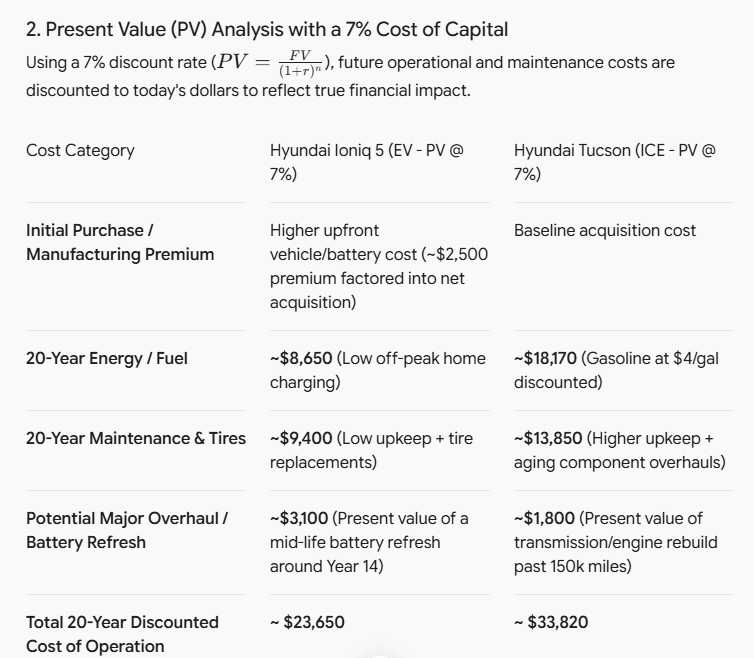
And lets say, just for the sake of argument, that you give a damn about the world you live in. It comes out way way ahead in that regard as well.
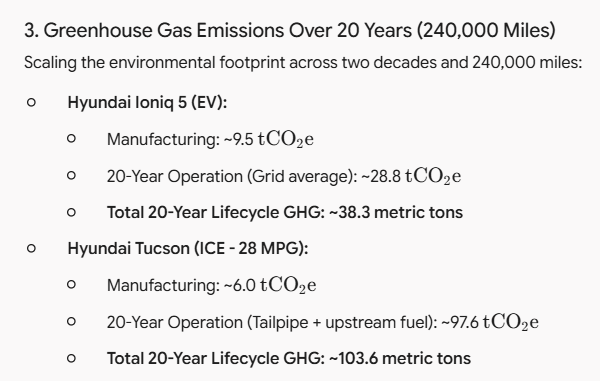
Assuming a social cost of greenhouse gas emissions of $200/MT (from the pre-Trump EPA) that implies an additional $7,660 in environmental costs for the Ionq and $20,720 for the Tuscon. You can see where this is going.
As with most cars, the most economical solution is to buy a used car that’s in good shape and keep it for a long time, and this may be especially true of EVs that have lower maintenance costs and excellent longevity.
Still, I recognize that there are some people who prefer to drive $80,000+ jacked up pickup trucks that get 14 mpg. There is no arguing with this on a rational basis, so I wrote about them in song form.


0 comments on “The Longevity of EVs”